Somya Goyal on the Unscripted SaaS Podcast: AI brand visibility & citations
This conversation was recorded in July 2026, before launch. Stellarcast is now generally available with public pricing, so the early-access and pricing answers below are out of date. Changes go to WordPress as drafts; Shopify publishing is not available yet, and there is no Webflow integration.
Stellarcast founder Somya Goyal joined Jeremy Rivera on the Unscripted SaaS Podcast to talk about what it takes to be named when buyers ask AI for a recommendation - why citations aren't rankings, how fast the models actually change their minds, and the continuous loop behind Stellarcast. Lightly edited highlights below.
Jeremy Rivera: Hello, I'm Jeremy Rivera, your Unscripted SEO and small-business podcasting host. I'm here with Somya Goyal, who's going to introduce Stellarcast - her SaaS - and introduce herself and her product.
Somya Goyal: Hi everyone, hi Jeremy. My name is Somya Goyal. I am the founder of Stellarcast. Stellarcast is a platform that manages how your brand is seen in the AI world. So when someone asks ChatGPT, Claude, Perplexity or Gemini, "what's the best X?" the model names a couple of brands. Stellarcast watches whether you are one of them.
It figures out if you are missing, and if you're missing, it ships the fix. It actually proves that the needle has moved - that you are there after the fix has been done. Think of it as a system of AI records: that you are being cited, that you are being considered, and that you are being chosen.
So it is basically a dashboard. But where other dashboards give you a one-time view, this is a continuous process. It completes the whole flywheel: it figures out what the problem is, it's fixed, and it runs continuously.
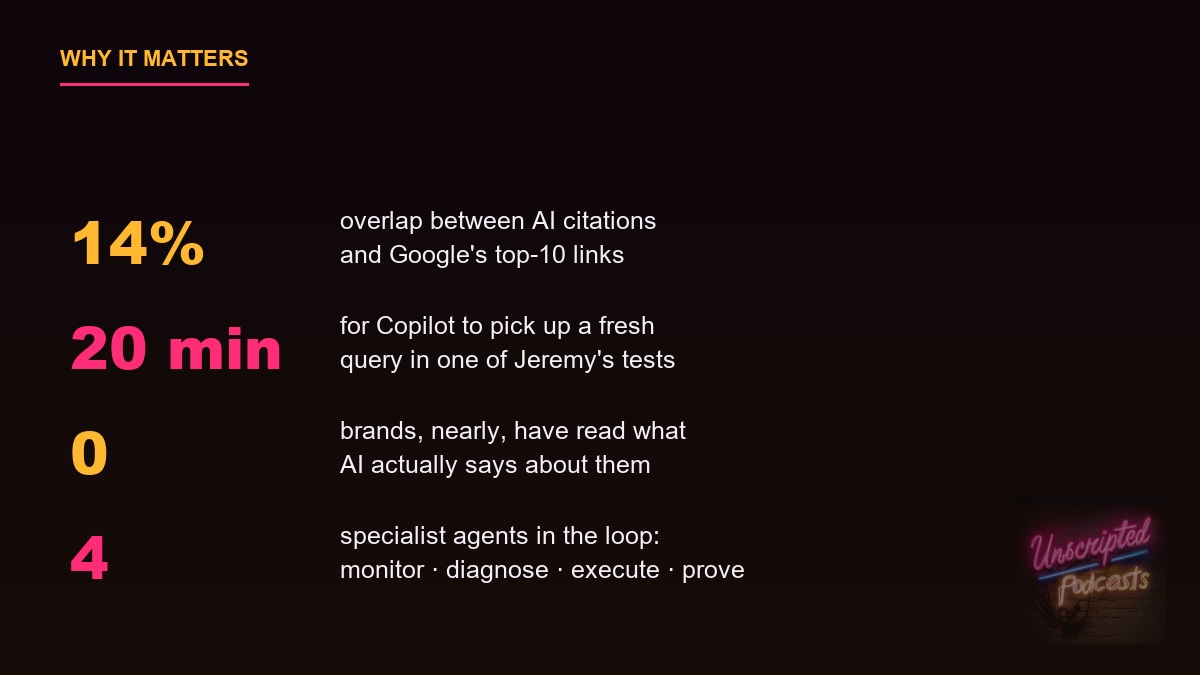
The four-agent loop: monitor, diagnose, execute, prove
Jeremy: What are some of the things in the bucket of actions you're doing to increase the visibility of those citations? Let's say, first cut, you're not getting seen very much - what are the steps your program takes to improve the visibility of those citations?
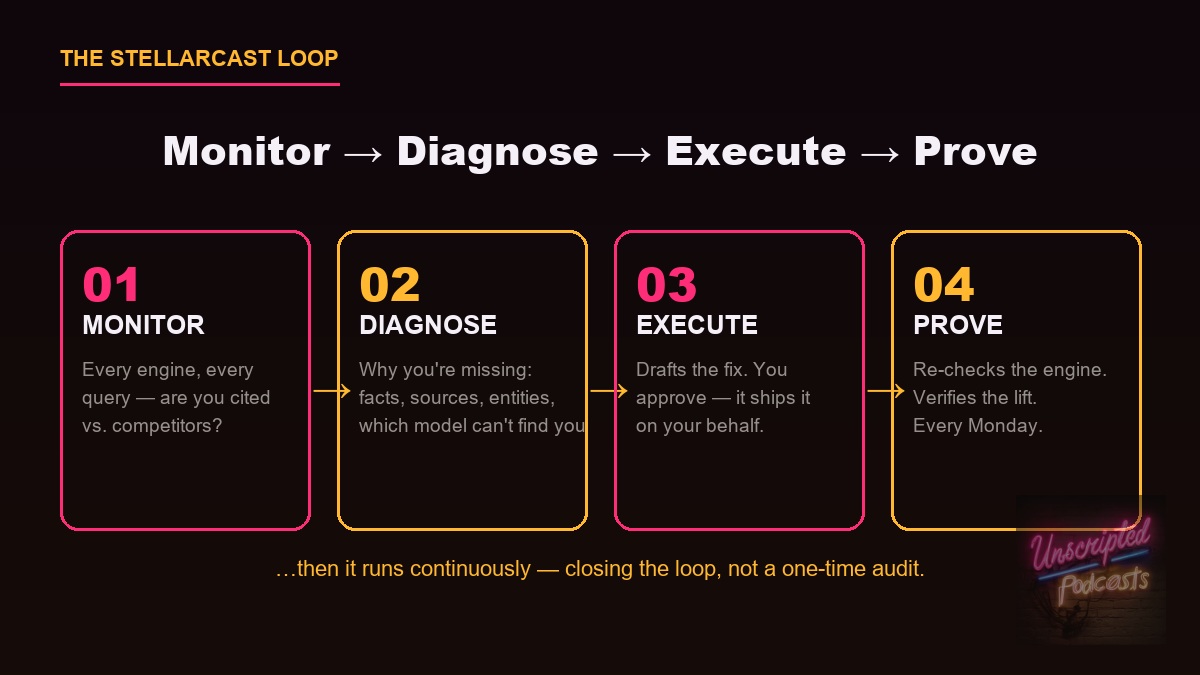
Somya: It's basically a loop run by specialist agents. One monitors every engine for how you are cited versus your competitors. Another diagnoses why you are missing - the facts, the sources, the entities, and which model can't find you. You don't know which user is using which model, so it also identifies which model you're missing from.
It drafts the fix, and once you approve it, it ships the fix on your behalf. Then it re-checks in the engine that the fix you pushed is actually working, and it verifies the lift. So it is basically monitor, diagnose, execute, and then prove. Most of the tools stop at the dashboard. The whole point of Stellarcast is closing the loop - keeping things in a log and moving continuously, rather than a one-time audit or one-time fix.
"Most of the tools stop at the dashboard. The whole point of Stellarcast is closing the loop."Somya Goyal
Curious whether AI engines name you when buyers ask about your category? Get a free visibility audit and see where you stand across ChatGPT, Gemini, Perplexity and Google AI Overviews.
CMS integrations and building in the open
Jeremy: So you have integrations with WordPress, Shopify, and Webflow. After the diagnosis, it gives you suggestions of additions to make to your site to fill the query and intent gaps you found in the citations. Is that right?
Somya: Yeah, it basically gives you the fixes. You just need to approve and do it. Currently it's early and building in the open, so we are onboarding a focus group of pilot brands and agencies as design partners. Right now I'm sharing what I learn on LinkedIn. It's at an early stage and in a continuous building phase.
How the models behave differently - and why citations aren't rankings
Jeremy: What are some of the differences you're seeing in behavior between the different models that surprised you?
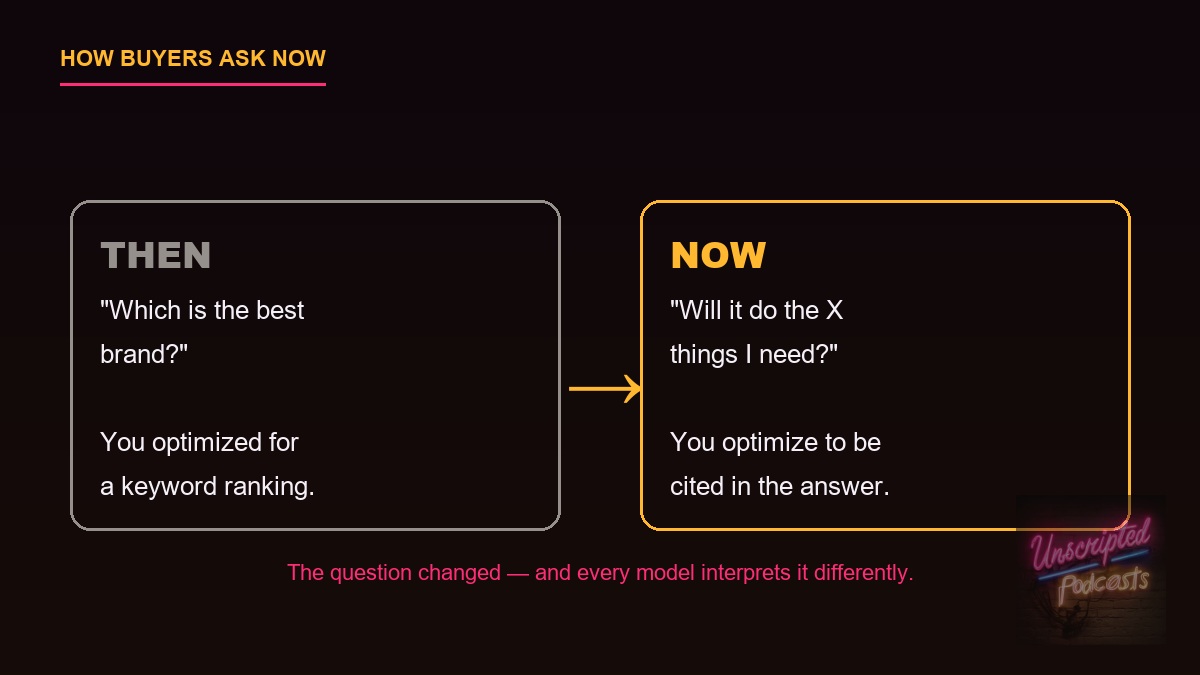
Somya: Now people ask questions on AI differently. They don't ask "which is the best brand?" - they ask "will it do the X number of things for me?" So the questions have changed, and models interpret them differently. Different models find things in different ways, understand things in different ways, and respond in different ways. It depends what you ask and what you get from different models.
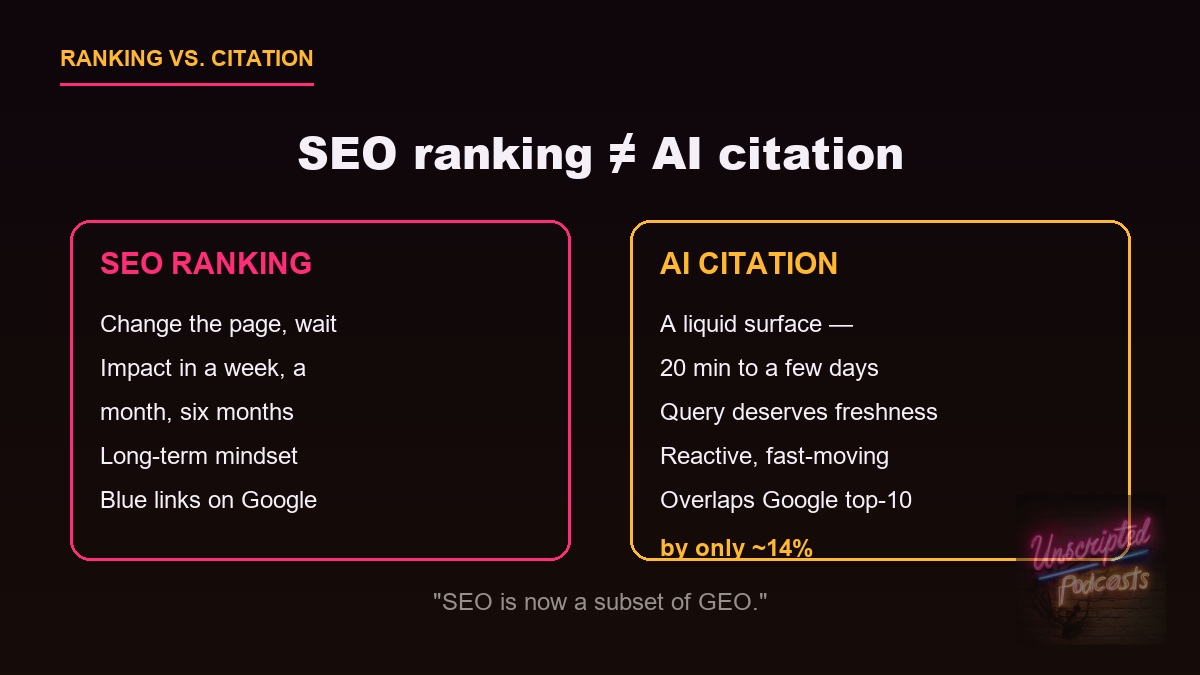
Jeremy: I'm curious about the turnaround window for freshness. From an SEO perspective, we're used to: I'll make a change on the page and maybe I'll see an impact in rankings in a week, a month, or six months. How quickly are you seeing AI models shift their answers based on the citable information you provide about yourself?
Somya: Ranking is different and citation is different. AI citations overlap Google's top-ten links by only fourteen percent - which I read in the last few months. You want to be cited in the AI answers. Right now, brands who want to be cited aren't sure what the AI is going to answer. As I was going through one of your broadcasts with Patrick, he said SEO is now a subset of GEO, which I really liked. SEO is twenty years old and is evolving with a new term - AI citations. We are basically starting from zero.
"Most of the brands have never read what AI says about them - and sometimes AI is confidently wrong."Somya Goyal
Freshness, lag, and the "liquid surface" of LLM answers
Jeremy: Once you suggest those changes and push them to production, have you seen nearly instant updates to fresh queries? Or is there lag time? Should you think of it differently than Google - that the LLMs pretty much forget the previous version and use the new, more thorough answers when they crawl the site?
Somya: That's something I'm watching too. I don't have concrete comments on that yet - I'd like to know what you're seeing. I've been around SEO for the past fifteen years or so.
Jeremy: I have a handful of cases. I launched something like a community cleanup for clean air, and it took about twenty minutes for Microsoft Copilot to recognize it when I queried, "is there a cleanup in this park in Colorado?" But other queries referencing new information for a brand took a full day. With events, there might actually be an API connection between Eventbrite and ChatGPT, because that showed up almost immediately. It depends on the query space - whether it's referring to its training database, third-party data sources, or pulling again from the SERPs.
A few days is a lot shorter than the cycle of trying to re-rank a query on Google. It's almost like we should treat it as a more liquid surface. Our plan and mindset for SEO is always so long-term, but the models seem much more focused on reactiveness and the desire for freshness. Query deserves freshness - QDF - seems super high in LLMs. Is that what you're seeing?
Somya: Yeah. When you want to measure whether the model says your name or not - most brands have never read what AI says about them, and sometimes AI is confidently wrong. It cites data that's maybe two years old - the pricing, the reviews - even after a lot of fresh data. Where it's picking that from is something I'm also watching.
AI as your least-trained support rep
Jeremy: Matt Brooks says ChatGPT is your least-trained customer support representative - so you need to give it some training. And you can't do that training if you're not listening to the answers it's giving people. It's like a rogue knowledge base that's out of our control initially. So your SaaS is aimed at opening that up - becoming your interface to understand what answers are being given based on your own content. You're not partnering to get third-party citations placed; your tool is focused on what you're saying about yourself, or what isn't currently said, that AI might be misrepresenting.
Somya: Yes. It's monitoring - first, are you cited or not? If a user asks about, say, cruelty-free shampoos, are you present or not in the AI answers? That's the first question. And if not, why? It has to monitor through every LLM platform continuously. This cannot be a one-time process. Maybe today the LLM answers in a certain manner, but two or three days down the line it might change its background search, name your competitor, and cross you out. So: monitor, then diagnose what's happening, then execute the fix, and prove - let's say every Monday it proves that for X number of questions, the LLMs cite you, mention you, make you visible.
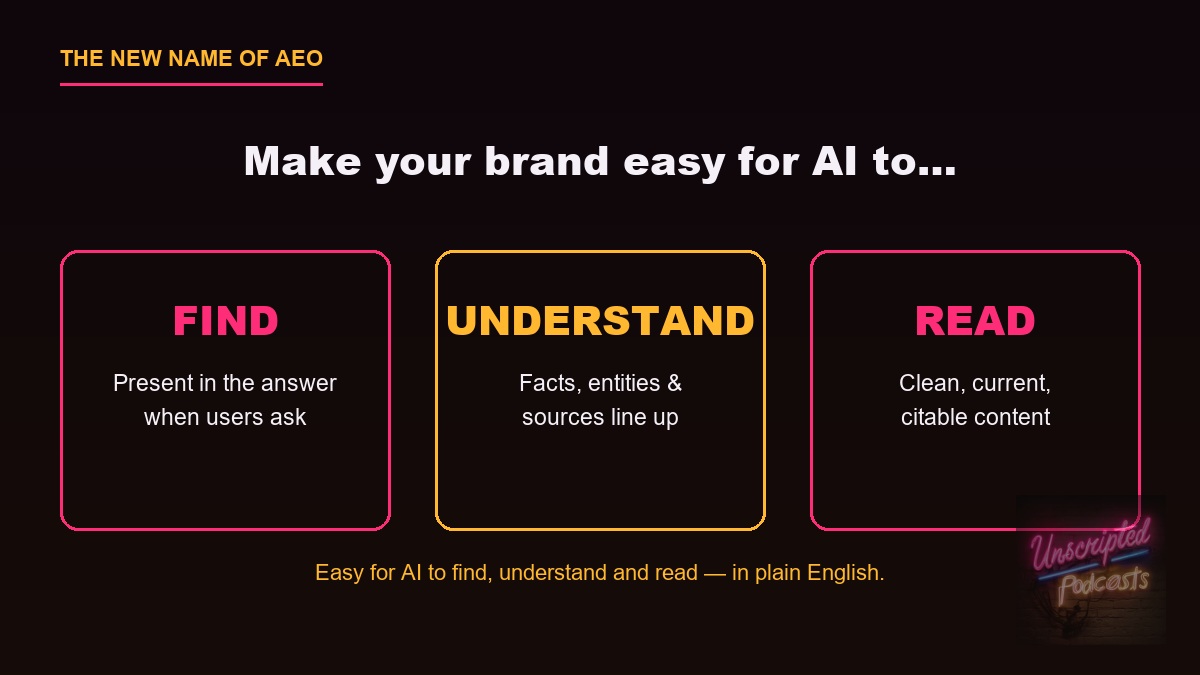
Somya: Visibility in AI is simple. Make your brand easy for AI to find, understand, and read. That is the new name of AEO, in very simple English.
"Make your brand easy for AI to find, understand, and read. That is the new name of AEO."Somya Goyal
From fifteen years in QA to first-time founder
Jeremy: Is this your first SaaS that you've founded? What space were your other projects in?
Somya: Coming to my background: I've been doing fifteen-plus years of quality engineering - eight years at Accenture, then leading QA independently and building validation frameworks for AI systems. I owned quality for enterprise programs for years, so shipping something with my own name on it is a different kind of exposure - building for global brand markets from India. As of now, I'm being live on LinkedIn with some engines. I see this problem is there with everyone coming into the new AI world. That's how I thought of building it - being a first-time founder in my career.
Jeremy: Is there any detail on the back-end platform you've chosen?
Somya: I have a colleague - he's the CTO at Stellarcast. He's looking after all the technical stuff. I just focus on the product idea, the design, and the other pieces.
Market fit: SMBs, agencies, and the human-in-the-loop
Jeremy: It's an area of conversation I've had with different agency owners. Talking with my friend Timothy Jackson - he's got a Nashville SEO agency - it's something our clients are bringing to the table. They want clarity of information and action items they can take. There's potential market fit here. If you're a housing contractor or a roofer, you want a solution that doesn't just give you a dashboard that means something to somebody else, but actually suggests things. Being able to work "what was the impact of this" right into the same UX - that's an effective bundle.
Somya: The human in the loop is always needed. Other dashboards just give you a one-time audit or monitor. Mine is totally continuous and independent. It gives you drafts of the fixes, and once you approve with the details given, it can also ship it, fix it, and move the needle for what you're looking for.
Early access and pricing
Jeremy: I appreciate you coming on and sharing about your SaaS. I'll make sure stellarcast.ai is linked in the show notes. You're in an early-access phase, looking for your first cohort or two to trial it. Do you have an estimate yet of the price point once you firm up the model?
Somya: Not exactly - because we are in the design phase, onboarding design partners. I want to focus on the brands right now, in pilot mode, not come out with pricing so early.
Jeremy: Fair enough. This has been an episode of Unscripted SaaS. You can catch more episodes at unscriptedsaas.com. Thank you so much for joining me, Somya.
Somya: Thank you for having me.
Key takeaways
- A continuous loop, not a one-time audit. Stellarcast runs four specialist agents - monitor, diagnose, execute, prove - and the whole point is closing the loop and proving the lift.
- Ranking and citation are different games. AI citations overlap Google's top-ten links by only about 14%, so being #1 on Google doesn't mean you're named in the answer.
- Most brands have never read what AI says about them - and models are sometimes "confidently wrong," citing two-year-old pricing or reviews even when fresher data exists.
- LLM answers behave like a liquid surface. Jeremy saw updates land in about 20 minutes (Copilot) up to a full day - far faster than Google's re-ranking cycle, with freshness (QDF) weighted heavily.
- The buyer's question shifted from "which is the best brand?" to "will it do the X things I need?" - and each model interprets that intent differently.
- AEO in plain English: make your brand easy for AI to find, understand, and read - with a human always in the loop to approve the drafted fixes before they ship.
See whether AI names you when buyers ask
Stellarcast monitors whether you're named and cited across ChatGPT, Gemini, Perplexity, Copilot, Google AI Overviews and AI Mode, diagnoses why competitors win the prompts you don't, ships the fix, and proves the lift. We're onboarding a focus group of pilot brands and agencies. Request a free audit and see where you stand.
Get your free visibility auditNew to this? Start with: What is Answer Engine Optimization (AEO)? →
Frequently asked questions
What is Stellarcast?
Stellarcast is a platform that manages how your brand is seen in the AI world. When someone asks ChatGPT, Claude, Perplexity or Gemini for the best option in a category, the model names a few brands. Stellarcast watches whether you are one of them, figures out why if you are missing, ships the fix once you approve it, and proves the lift - a continuous monitor, diagnose, execute, prove loop rather than a one-time audit.
Is being #1 on Google the same as being cited by AI?
No. As discussed on the podcast, AI citations overlap Google's top-ten links by only about 14 percent, so ranking and citation are different games. Being #1 on Google does not guarantee an AI model names you in its answer, which is why AI visibility has to be measured on its own terms.
How fast do AI answers update after a change?
Faster than Google re-ranking, and variable. In the conversation, host Jeremy Rivera described seeing Microsoft Copilot pick up a fresh query in about 20 minutes in one case, while other updates took a full day - behaving like a liquid surface that weights query freshness heavily, rather than Google's weeks-to-months cycle.