Why ChatGPT recommends your competitor instead of you
A buyer asks ChatGPT for the best option in your category, and the answer names a competitor. Not you. It is tempting to read that as a verdict on your product, but it rarely is. AI engines recommend what they can find, read, trust and quote, and when a competitor wins that is usually down to one specific, fixable gap. This guide covers the five gaps we see most, how to tell which one you have, and how to prove a fix actually worked.
ChatGPT names a competitor instead of you for one of five reasons: its crawlers cannot read your site, you are missing from the pages it cites for your category, competitors have more independent mentions, it has your facts wrong or missing, or nothing on your site answers the buyer's exact question. Find which one applies, fix your own site first, then earn third-party coverage, and measure the change against questions you did not touch.
The five reasons AI names a competitor instead of you
The same five causes show up across ChatGPT, Gemini, Perplexity and Copilot. The weights differ by engine, but the list does not.
- AI crawlers cannot read your site. If your robots.txt blocks crawlers such as GPTBot, OAI-SearchBot or PerplexityBot, or your key content only appears after JavaScript runs, the engine has nothing of yours to work with. A competitor whose pages are readable wins by default.
- You are missing from the sources the engine trusts. Engines build answers from a small set of pages they cite for a category: review sites, comparison articles, "best of" lists, forum threads. If your competitor appears on those pages and you do not, the answer is assembled without you. See which sources AI engines cite most.
- Competitors have more independent corroboration. AI engines discount what a brand says about itself and lean on what others say about it. A rival that is discussed on review platforms, in forums and in the press looks safer to recommend than a brand that only describes itself. Why brand mentions now matter as much as links.
- The engine has your facts wrong, or has none. Outdated pricing, a missing feature, the wrong category. An engine will not confidently recommend something it cannot confidently describe, so thin or contradictory facts push it toward the competitor it understands better.
- Nobody has answered the question on your site. Buyers ask specific questions: which tool suits a small team, which option works in their country, how two products compare. If a competitor has a page that answers that exact question and you do not, their page becomes the answer. How to structure a page so AI quotes it.
How to tell which one applies to you
Start with the questions, not your brand name. Asking an engine "what is [your brand]" tells you almost nothing about whether it recommends you. Write down the questions a buyer would really ask, such as "best project management tool for a remote agency" or "is [competitor] worth it", and run them in each engine you care about.
For each answer, record three things: whether you are named, which competitors are named, and which pages are cited. Then run the same questions again on a different day. AI answers are not deterministic, so a single run can mislead in either direction. How to measure share of voice in AI answers walks through building a baseline you can trust.
The citations tell you which gap you are looking at:
- Nothing of yours is ever cited, not even your homepage: check crawler access first. It is the fastest fix and it blocks everything else.
- Third-party pages are cited, and you are absent from them: that is a source or authority gap. The answer is being built from coverage you do not have yet.
- Your pages are cited, but you are described wrongly: that is a factual gap. The engine is reading you and getting the wrong picture.
- The competitor's cited page answers the question and none of yours does: that is a content gap.
Our self-serve audit checklist turns this into a scored worksheet if you want to do it by hand.
Want this done for your brand? Get a free visibility audit and see who AI names in your category, and why.
Fixing each cause, in the order that pays off
Fix what you own before chasing what you have to earn. Owned fixes are faster, fully in your control, and they make every earned mention work harder.
- Crawler access. Allow the AI crawlers you want to be read by, and make sure the facts that matter are in the page's HTML rather than behind a script or a click. This is usually an afternoon's work.
- Facts. Publish one clear page that states what you are, who you serve, what you cost and how you differ, in plain sentences an engine can quote. Keep the same facts consistent on your profiles elsewhere, such as review sites, company directories and social pages, because contradictions read as uncertainty. Does schema markup help?
- Answer pages. For each buyer question you lose, publish a page that answers it directly in the first paragraph, then supports the answer. One question per page beats one page for every question.
- Earned coverage. Get listed and reviewed on the sites the engines already cite for your category, and take part in the forums and comparisons where buyers ask. This is the slowest step and it cannot be faked: fabricated reviews and planted posts get discounted, and they put the brand at risk. A person writes the outreach and a person posts it.
Proving the fix worked
This is where most teams fool themselves. You make a change, check ChatGPT a week later, see your brand named, and call it a win. But engines update their models and their sources constantly, and your visibility can rise or fall for reasons that have nothing to do with your change.
Three habits keep the result honest:
- Keep a control group. Leave some of your tracked questions untouched. If the questions you fixed improve and the untouched ones do not, the change is likely yours. If both move together, it was the engine.
- Wait for enough readings. One good day is noise. Compare a stretch of readings before the change with a stretch after it.
- Label your confidence. Say "measured" only when the evidence is strong, "likely" when it points that way, and "too early" when it is too early. A claimed win that later disappears costs more credibility than an honest "not yet".
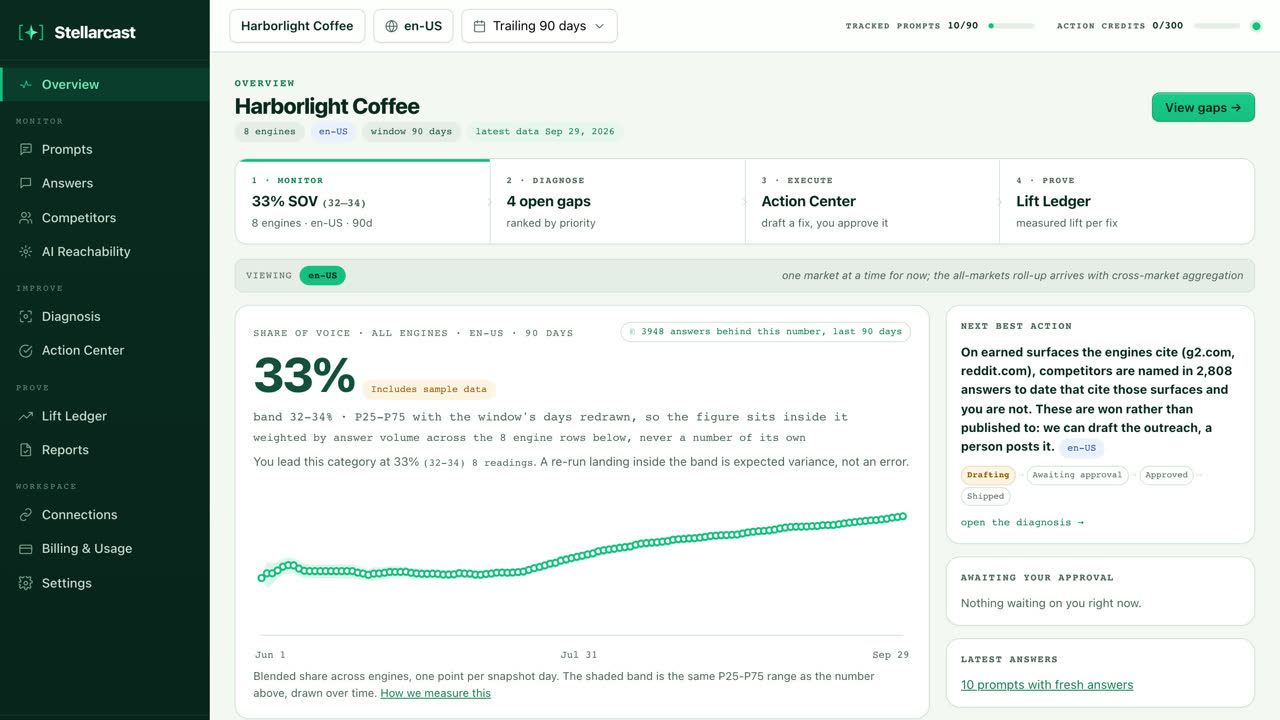
Here is what that loop looks like in Stellarcast: the visibility overview, the ranked gaps with their cause, a fix going through approval, and the ledger that labels whether it worked.
The takeaway
When AI recommends a competitor, treat it as a diagnosis problem, not a verdict. Find out which of the five gaps you have, fix what you own first, earn the coverage you cannot publish yourself, and measure the result against questions you left alone. Brands that do this steadily tend to show up more often, and they can prove why.
Find out why AI names your competitor
Stellarcast checks how AI engines like ChatGPT, Gemini and Perplexity answer your buyers' questions, shows which competitors they name instead of you, and traces each gap to its cause. Start with a free visibility audit, no card needed.
Get your free visibility auditFrequently asked questions
Why does ChatGPT recommend my competitor but not me?
Almost always for one of five reasons: AI crawlers cannot read your site, you are missing from the pages the engine cites for your category, competitors have more independent mentions on review sites and forums, the engine has your facts wrong or missing, or nothing on your site directly answers the buyer's question. Each has a different fix, so it pays to find out which one applies before changing anything.
How do I check which reason applies to my brand?
Ask the engines the questions your buyers actually ask, not your brand name, and record who is named and which pages are cited. Repeat each question several times, because answers vary run to run, and keep the results per engine. If the cited pages are third-party and you are absent from them, the gap is earned coverage; if your own pages are cited but describe you wrongly, it is factual; if nothing of yours is ever cited, check crawler access first.
How long does it take for a fix to show up in AI answers?
Anywhere from days to weeks, and it differs by engine, because each one refreshes what it knows on its own schedule. That is why a before-and-after check the day after a change proves nothing. Wait for a proper window, and compare the questions you changed against questions you did not touch.
Does good SEO stop AI from recommending competitors?
It helps, but it is not the same thing. Ranking on a results page and being named inside an AI answer are decided differently: AI engines lean heavily on corroboration from sources they trust, clear facts they can quote, and pages that answer the exact question. Plenty of brands with strong SEO are still invisible in AI answers.