Ask AI about coffee in Mexico or Argentina, and it cites Spanish websites
Spain, Mexico and Argentina share a language, but not a coffee market. When someone in Mexico City or Buenos Aires asks an AI assistant which coffee to buy, whose websites does the answer rely on? We asked ChatGPT, Gemini, Google AI Mode and Perplexity the same 14 coffee questions in all three countries, in Spanish and in English, and in Catalan in Spain, three times each.
What we found
In this data, sources travelled one way. 69 of 504 answers in Mexico and Argentina (14%) cited at least one Spanish website: 113 Spanish citations in Mexican answers and 102 in Argentine ones. Not one answer in Spain cited a Mexican or Argentine site. The Spanish sites showed up mostly on questions about global products, such as bean-to-cup machines and decaf, rather than local shops. And the language of the question changed the sources sharply: asked in Spanish, 44% to 81% of the sources an engine cited came from the country the question was asked in. Asked in English, from the same location, it was 18% to 56%.
“Ask in Spanish from Mexico or Argentina and the answer reads local. Often the sources aren’t.”
David Carrasco Pamies, Strategic SEO consultant, founder of Magnify
Key figures
- 14% of AI answers to coffee questions asked in Mexico and Argentina cited at least one website from Spain.
- No answer asked from Spain cited a Mexican or Argentine website.
- On the question about bean-to-cup coffee machines, 47% of answers in Mexico and Argentina cited a Spanish website.
- Asked in English instead of Spanish, the share of sources from the asking country fell from 78% to 23% for Google AI Mode in Spain.
- With no location set, 30% of the sites Perplexity cited in Spanish were from Spain, against 6% from Mexico and 5% from Argentina.
- 60 of the 215 citations of Spanish websites in Mexican and Argentine answers pointed to the shopping sections of Spanish newspapers (analysis by David Carrasco Pamies).
- Only 1 of the 69 answers in Mexico and Argentina that cited a Spanish website mentioned Spain in its text (analysis by David Carrasco Pamies).
How we ran it
- Questions: 14 coffee questions written with David Carrasco Pamies (listed at the end). Some name the country ("which coffee subscription is worth it in Mexico?"), some do not and rely on the location alone ("which decaf tastes best?"). Mexican and Argentine wording was adapted to local usage.
- Location: ChatGPT was set to the country. Google AI Mode and Gemini were set to the capital (Madrid, Mexico City, Buenos Aires), and to Barcelona for the Catalan questions. In our setup Perplexity receives no location, so it shows the effect of language only.
- Languages: Spanish and English in each country, and Catalan in Spain.
- Repeats: every question was asked 3 times in each language and country, because AI answers vary from run to run.
- What we measured: the websites each answer cited, and which country each site belongs to: by its country domain (.es, .mx, .ar) and, for .com and other domains, by reading the site. Publishers and brands with national editions or stores (El País, Infobae, ¡Hola!, Nespresso, Nescafé, Time Out) are counted by the edition each link points to. David Carrasco Pamies checked every site we placed in Spain.
- Checks: every answer was kept. Answers citing a site from another of the three countries are part of the findings and were never asked again. Every answer was checked for two responses joined into one, a problem an early test had shown; none was found. No question returned the same text twice across its runs. All 882 answers from ChatGPT, Google AI Mode and Gemini confirmed the location we set.
- Size: 1,065 answers, collected on 19 November 2026.
Finding 1: Mexican and Argentine answers cite Spanish websites, and not the other way round
Answers that cited at least one website from Spain, out of all answers asked from each country (Spanish and English questions together):
| Engine | Mexico: cited a Spanish site | Argentina: cited a Spanish site | Spain: cited a Mexican or Argentine site |
|---|---|---|---|
| ChatGPT | 8 of 84 (10%) | 11 of 84 (13%) | 0 of 126 |
| Google AI Mode | 11 of 84 (13%) | 11 of 84 (13%) | 0 of 126 |
| Gemini | 13 of 84 (15%) | 15 of 84 (18%) | 0 of 126 |
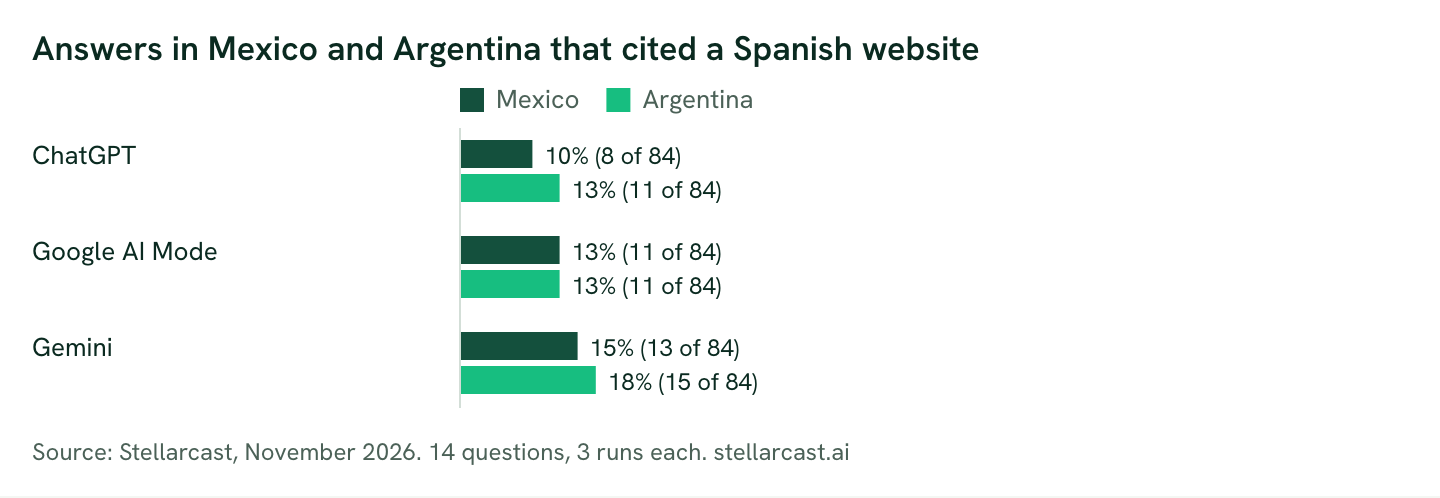 ChatGPT: Mexico 10%, Argentina 13%; Google AI Mode: Mexico 13%, Argentina 13%; Gemini: Mexico 15%, Argentina 18%. No answer asked from Spain cited a Mexican or Argentine website.
It happens almost only in Spanish. Of the answers in Mexico and Argentina asked in Spanish, 66 of 252 cited a Spanish site; asked in English, 3 of 252. The Spanish sites cited most often in Mexican and Argentine answers were La Vanguardia (27), cafesmyway.com (17), sanjorge.cafe (15), Incapto (14), laboutiquedigod.com (12), El País (11), ABC (11), lecuine.com (9).
On which questions did Spanish sites appear? Mostly those about products sold everywhere. On those questions 27% to 33% of answers in Mexico and Argentina (depending on engine) cited a Spanish site, against 0% to 8% on questions that named the country and 0% to 6% on local questions that did not name the country (shops, subscriptions, roasters, sustainable brands):
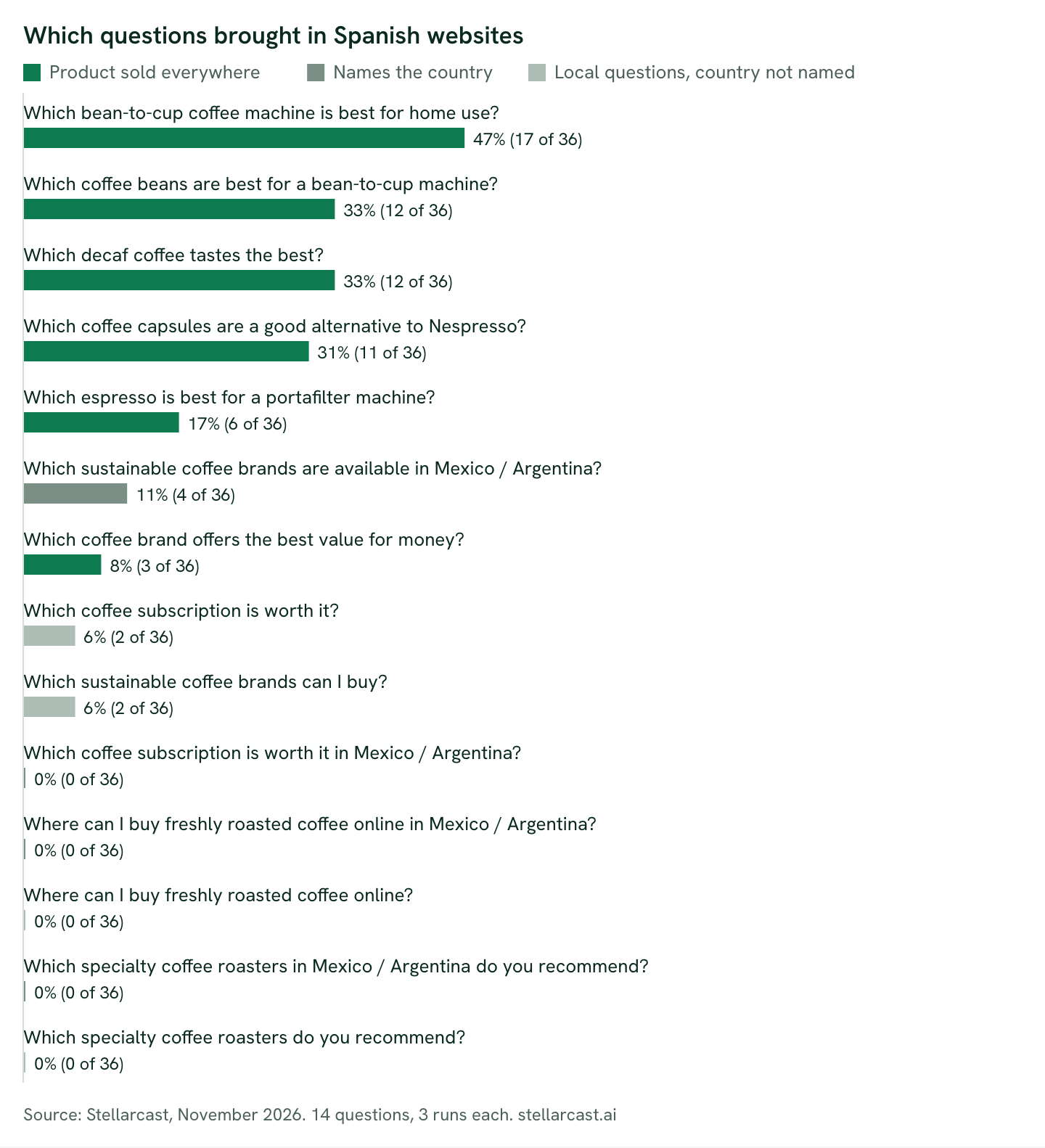 Share of answers in Mexico and Argentina citing a Spanish site, by question: Which bean-to-cup coffee machine is best for home use? 47%; Which coffee beans are best for a bean-to-cup machine? 33%; Which decaf coffee tastes the best? 33%; Which coffee capsules are a good alternative to Nespresso? 31%; Which espresso is best for a portafilter machine? 17%; Which sustainable coffee brands are available in Mexico / Argentina? 11%; Which coffee brand offers the best value for money? 8%; Which coffee subscription is worth it? 6%; Which sustainable coffee brands can I buy? 6%; Which coffee subscription is worth it in Mexico / Argentina? 0%; Where can I buy freshly roasted coffee online in Mexico / Argentina? 0%; Where can I buy freshly roasted coffee online? 0%; Which specialty coffee roasters in Mexico / Argentina do you recommend? 0%; Which specialty coffee roasters do you recommend? 0%
| Question (English version) | Answers in Mexico and Argentina citing a Spanish site |
|---|---|
| Which bean-to-cup coffee machine is best for home use? | 17 of 36 (47%) |
| Which coffee beans are best for a bean-to-cup machine? | 12 of 36 (33%) |
| Which decaf coffee tastes the best? | 12 of 36 (33%) |
| Which coffee capsules are a good alternative to Nespresso? | 11 of 36 (31%) |
| Which espresso is best for a portafilter machine? | 6 of 36 (17%) |
| Which sustainable coffee brands are available in Mexico / Argentina? | 4 of 36 (11%) |
| Which coffee brand offers the best value for money? | 3 of 36 (8%) |
| Which coffee subscription is worth it? | 2 of 36 (6%) |
| Which sustainable coffee brands can I buy? | 2 of 36 (6%) |
| Which coffee subscription is worth it in Mexico / Argentina? | 0 of 36 (0%) |
| Where can I buy freshly roasted coffee online in Mexico / Argentina? | 0 of 36 (0%) |
| Where can I buy freshly roasted coffee online? | 0 of 36 (0%) |
| Which specialty coffee roasters in Mexico / Argentina do you recommend? | 0 of 36 (0%) |
| Which specialty coffee roasters do you recommend? | 0 of 36 (0%) |
Finding 2: ask in English, and the local sources fall away
Asked in Spanish, 44% to 81% of the sources an engine cited came from the country the question was asked in. Asked in English, from the same location, it was 18% to 56%. The gap was widest for Google AI Mode in Spain (78% in Spanish, 23% in English) and narrowest for ChatGPT in Argentina (66% and 56%). The location was the same; only the language changed.
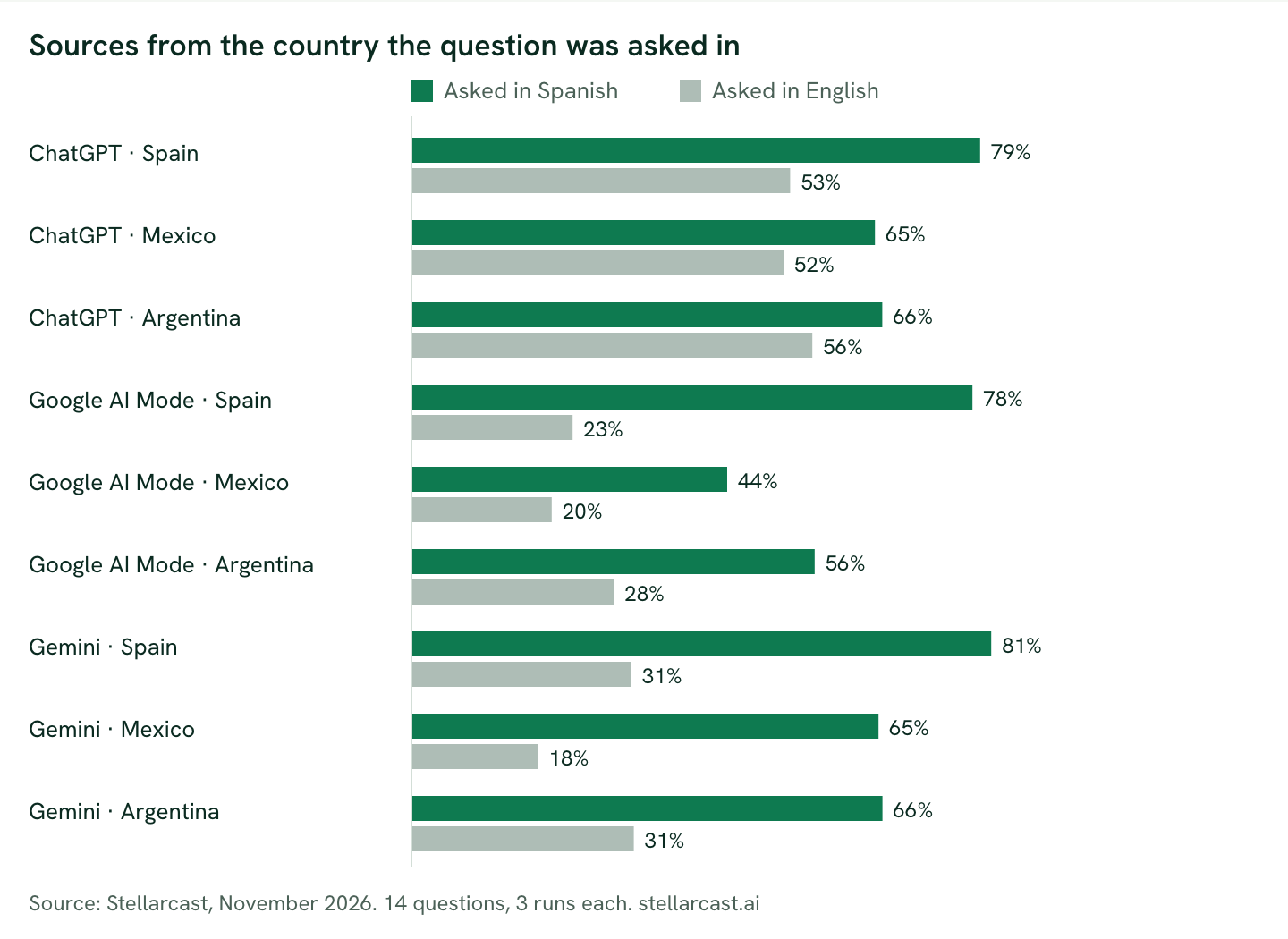 ChatGPT · Spain: Spanish 79%, English 53%; ChatGPT · Mexico: Spanish 65%, English 52%; ChatGPT · Argentina: Spanish 66%, English 56%; Google AI Mode · Spain: Spanish 78%, English 23%; Google AI Mode · Mexico: Spanish 44%, English 20%; Google AI Mode · Argentina: Spanish 56%, English 28%; Gemini · Spain: Spanish 81%, English 31%; Gemini · Mexico: Spanish 65%, English 18%; Gemini · Argentina: Spanish 66%, English 31%
Catalan answers in Spain drew on Spanish sites almost as much as Spanish-language ones: 77%, 72%, 73% of sources (ChatGPT, Google AI Mode, Gemini), against 79%, 78%, 81% when asked in Spanish.
Finding 3: with no location set, Spanish answers cited mostly Spanish sites
Perplexity receives no location in our setup, so it only sees the language. Asked in Spanish, 30% of the sites it cited were from Spain, 6% from Mexico and 5% from Argentina, even though 24 of its 75 Spanish answers were to questions naming Mexico or Argentina. This suggests that, without a location, the Spanish-language web an engine draws on leans towards Spain.
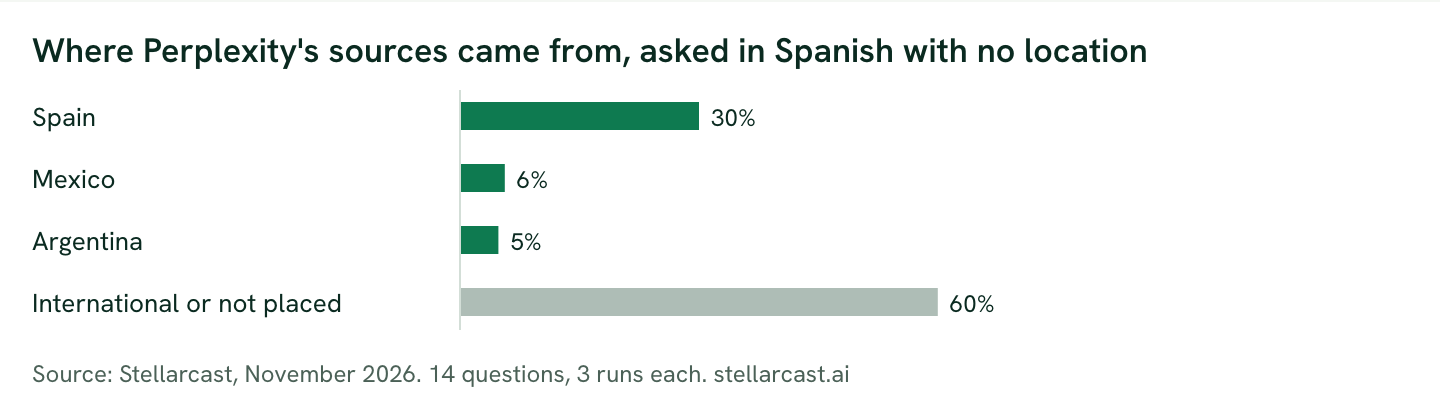 Spain 30%, Mexico 6%, Argentina 5%, international or not placed 60%, of 750 cited sites.
Per engine and country
| Engine | Country | Answers | Sites cited | From the asking country | Answers citing another of the three countries |
|---|---|---|---|---|---|
| ChatGPT | Spain | 84 | 649 | 65% | 0 (0%) |
| ChatGPT | Mexico | 84 | 625 | 58% | 8 (10%) |
| ChatGPT | Argentina | 84 | 497 | 61% | 11 (13%) |
| Google AI Mode | Spain | 84 | 273 | 56% | 0 (0%) |
| Google AI Mode | Mexico | 84 | 267 | 35% | 11 (13%) |
| Google AI Mode | Argentina | 84 | 280 | 46% | 11 (13%) |
| Gemini | Spain | 84 | 916 | 59% | 0 (0%) |
| Gemini | Mexico | 84 | 1026 | 47% | 13 (15%) |
| Gemini | Argentina | 84 | 1006 | 50% | 15 (18%) |
What this means for Spanish-language markets
By David Carrasco Pamies
Ask ChatGPT, Gemini or Google AI Mode in Spanish for the best bean-to-cup machine for your home, from Mexico City or Buenos Aires. In this study, 17 of those 18 answers cited Spanish websites.
I’ve spent most of this year on what I call the Global Spanish problem: a shared language hiding differences that matter once someone acts on an answer. I wrote about what it means for AI search visibility and a practical framework for Spanish markets in Search Engine Land, and took it to Search Central Live Deep Dive Europe as a poster in October. In one of the poster examples, ChatGPT answered a question about registering as self-employed with Spain’s procedures, and said so in the first line: “Si te refieres a España”, if you mean Spain. A disclosed assumption. This data shows the same default at a larger scale, in the sources, and mostly without the disclosure.
Local questions, like where to buy freshly roasted coffee or which roaster to try, stayed almost entirely local. The leak shows up where the product is global and the buyer’s country seems to matter very little to the engine.
What travels is mostly shopping content. The affiliate sections of Spanish newspapers (La Vanguardia’s /comprar/, ABC’s Favorito, ¡Hola!’s Selección and a few more) account for 60 of the 215 Spanish citations in Mexican and Argentine answers. On the bean-to-cup question, all 17 answers that cited Spain cited at least one of them. And that “if you mean Spain” is missing here: only one of the 69 answers citing a Spanish site mentions Spain in its text. The answers read perfectly well. Whether they apply is another matter, since the guides behind them link to Amazon.es and other Spanish stores.
What I’d do with this. My guess is that engines cite what exists, and for global products in Mexico and Argentina not much local buying content exists yet. What that means depends on where you sit.
If you’re a Latin American brand or retailer, your competitor in these answers may well be a Spanish newspaper’s affiliate list. Ask your top product questions in Spanish from your own country, note which domains get cited, and publish the comparison and buying pages that are missing, with your prices, your retailers and your shipping.
If you’re a Spanish brand, you’re probably showing up in Latin America without trying. Check whether anyone there can actually buy what the answer recommends. A mention with nowhere to buy is reach that goes nowhere.
If you run a Spanish publisher’s commerce section, your guides are being read in Monterrey and Rosario through AI answers, with affiliate links to Spanish stores. That’s traffic you aren’t earning from.
And if you run a Mexican or Argentine publisher, the gap is right there. People ask these questions, the local shopping guides mostly don’t exist, and for now the engines fill that space with Spain.
It isn’t only Spanish. Ulrike Langer found something close to this in German news last week. Using data Stellarcast collected for her News Machines newsletter (Stellarcast’s write-up), she showed that German newsrooms largely disappear from AI answers when the same questions about Germany are asked in English. She also points to a University of Zurich study in which Swiss outlets became the main source once a question referred explicitly to Switzerland. That matches what we saw here: questions that name the country stayed local. The leak appears when the engine has to work out the market on its own. My guess is that in a language shared by several countries, it leans towards the one with the most content. For German, that’s probably Germany. For Spanish, it’s Spain.
This is coffee, measured on a single day, and I may be wrong about how far it reaches beyond this category. Still, if a buyer in Mexico asking about a coffee machine gets a Spanish shopping guide 17 times out of 18, I’d check my own category before assuming it’s safe.
David’s full analysis, including a comparison with classic Google results: The answer spoke Mexican Spanish. Its sources were in Spain. (LinkedIn).
What this means for brands
- In Latin America, your AI competitor may be a Spanish blog. On global product questions, answers in Mexico and Argentina cited Spanish review sites, media and shops.
- Publish in the market's own Spanish. The data suggests that where a question has little local coverage, Spanish sites stand in: they appeared mostly on questions about global products and rarely on questions about local shops.
- Check in the language your customers use. The same question from the same location, asked in English, cited a very different set of sources.
- Spanish sites can reach beyond Spain. A Spanish site that is cited in AI answers at home may also be cited in answers in Mexico and Argentina.
Limits of this study
- One category (coffee), 14 questions, 3 runs, one day.
- The study shows which sources answers cite, not why an engine chose them.
- Sites are placed in a country by domain and by reading the site; less-cited sites we did not place count as not local, so the local shares above are a floor. coffeeness.de, a German site with a Spanish edition priced in euros for buyers in Spain, is counted as international.
- ChatGPT is set to a country, not a city, so its local answers may draw on any city in the country.
- This first report covers sources. Which brands each answer names, compared across the three countries, follows in a second report.
Frequently asked questions
Do AI answers in Mexico and Argentina cite websites from Spain?
Yes. In this study, 14% of answers asked from Mexico and Argentina cited at least one Spanish website, most often on questions about products sold in every market, such as bean-to-cup coffee machines and decaf. No answer asked from Spain cited a Mexican or Argentine website.
Does the language of a question change which sources AI cites?
Yes, sharply. Asked in Spanish, 44% to 81% of the sources an engine cited came from the country the question was asked in. Asked in English, from the same location, it was 18% to 56%. The location was the same in both cases; only the language changed.
Which AI engines did the study test?
ChatGPT, Google AI Mode, Gemini and Perplexity. ChatGPT was set to each country, and Google AI Mode and Gemini to its capital. In our setup Perplexity receives no location, so it shows the effect of language only.
How can a brand in Mexico or Argentina get cited more in AI answers?
This study shows which sources were cited, not why. The pattern suggests that where little local content covers a product, answers in Mexico and Argentina cite Spanish websites instead: they appeared mostly on questions about global products. Reviews, comparisons and press coverage written for the local market give the engines a local source to cite. Check the result by asking the same questions several times, in the language your customers use.
Can I reuse this data?
Yes. The data is published under CC BY 4.0. Please link to this page when you quote a figure, so readers can see the method and its limits.
Resumen en español
Preguntamos a ChatGPT, Gemini, Google AI Mode y Perplexity 14 preguntas sobre café en España, México y Argentina, en español, inglés y catalán, tres veces cada una. Las respuestas en México y Argentina citaron webs españolas (14% de las respuestas), sobre todo en preguntas sobre productos globales como cafeteras superautomáticas o descafeinado. Ninguna respuesta en España citó una web mexicana o argentina. Y el idioma cambió las fuentes: preguntando en inglés desde el mismo lugar, las fuentes locales cayeron con fuerza.
The questions
| # | English | Spanish (Spain) |
|---|---|---|
| 1 | Which coffee beans are best for a bean-to-cup machine? | ¿Qué café en grano es mejor para una cafetera superautomática? |
| 2 | Which coffee subscription is worth it in [country]? | ¿Qué suscripción de café merece la pena en España? |
| 2b | Which coffee subscription is worth it? | ¿Qué suscripción de café vale la pena? |
| 3 | Where can I buy freshly roasted coffee online in [country]? | ¿Dónde comprar café recién tostado online en España? |
| 3b | Where can I buy freshly roasted coffee online? | ¿Dónde comprar café recién tostado online? |
| 4 | Which specialty coffee roasters in [country] do you recommend? | ¿Qué tostadores de café de especialidad me recomiendas en España? |
| 4b | Which specialty coffee roasters do you recommend? | ¿Qué tostadores de café de especialidad me recomiendas? |
| 5 | Which espresso is best for a portafilter machine? | ¿Qué café es el mejor para una cafetera de brazo? |
| 6 | Which coffee brand offers the best value for money? | ¿Qué marca de café tiene la mejor relación calidad-precio? |
| 7 | Which bean-to-cup coffee machine is best for home use? | ¿Cuál es la mejor cafetera superautomática para casa? |
| 8 | Which sustainable coffee brands are available in [country]? | ¿Qué marcas de café sostenible se pueden comprar en España? |
| 8b | Which sustainable coffee brands can I buy? | ¿Qué marcas de café sostenible se pueden comprar? |
| 9 | Which decaf coffee tastes the best? | ¿Qué café descafeinado tiene mejor sabor? |
| 10 | Which coffee capsules are a good alternative to Nespresso? | ¿Qué cápsulas de café son una buena alternativa a Nespresso? |
Questions 2b, 3b, 4b and 8b are questions 2, 3, 4 and 8 without the country, so the answer relies on location alone. [country] is the country the question was asked from. Mexican and Argentine versions adapt the wording to local usage.
Cite or reuse this study
The data is free to reuse under CC BY 4.0. If you quote a figure, please link to this page so readers can see the method and the limits above. To cite it:
Goyal, S. and Carrasco Pamies, D. (2026). "Ask AI about coffee in Mexico or Argentina, and it cites Spanish websites." Stellarcast. https://stellarcast.ai/blog/ai-coffee-answers-spain-mexico-argentina/
- Answers in Mexico and Argentina citing a Spanish site, as CSV
- Sources from the asking country, by language, as CSV
- The most-cited websites and the country of each, as CSV

See which sources AI uses in your market
Stellarcast measures whether your brand is named, and which sites the answer relies on, across ChatGPT, Gemini, Perplexity, Copilot and Google's AI answers, in each market and language.
Get your free visibility audit