Ask AI about German news in German or in English, and it reads different newsrooms
In October we found that asking AI engines about coffee in the local language, instead of English, changed the brands they named and the websites they cited. Coffee brands are very local. News is not: the budget, the war in Ukraine and the US elections are covered by German and international outlets alike. So does the language gap hold for news?
What we found
Yes, though a little less than for coffee. We asked 10 news questions in German and in English, both from Germany, twice each, on four AI engines. A German answer and an English answer to the same question had a median 11% of their cited websites in common; the same question asked twice in one language had 50%. German answers drew a median 44% of their citations from German-language newsrooms. English answers drew 0% and cited Reuters, AP, the BBC and Deutsche Welle's English service instead.
How we ran it
- Questions: 10 news questions a German reader might ask an AI assistant: the federal budget, electricity prices, pensions, conscription, the 2026 US midterms, the war in Ukraine, the Mecklenburg-Vorpommern state election, the week's news in Munich, and where to read reliable news on politics and on business. Each was written in natural German, with an English version of the same question. The full list is below.
- Location: both versions were asked from Germany, so the only thing that changed was the language. In our setup Perplexity receives no location at all, so for Perplexity the difference is language alone.
- Engines: Perplexity, Google AI Mode, Gemini and ChatGPT, collected through the same data sources Stellarcast uses in production. Microsoft Copilot is not included in this round.
- Repeats: every question was asked twice in each language, minutes apart. AI answers vary from run to run, so the second run is the yardstick: a language difference only counts if it is bigger than the difference between two runs of the same question.
- What we measured: the websites each answer cited. We compared them as sets (the number of websites in both answers divided by the number in either), and counted the share of citations on .de domains and on German-language news publishers.
- Size: 160 answers, collected on 12 November 2026.
Finding 1: German and English answers cite different websites
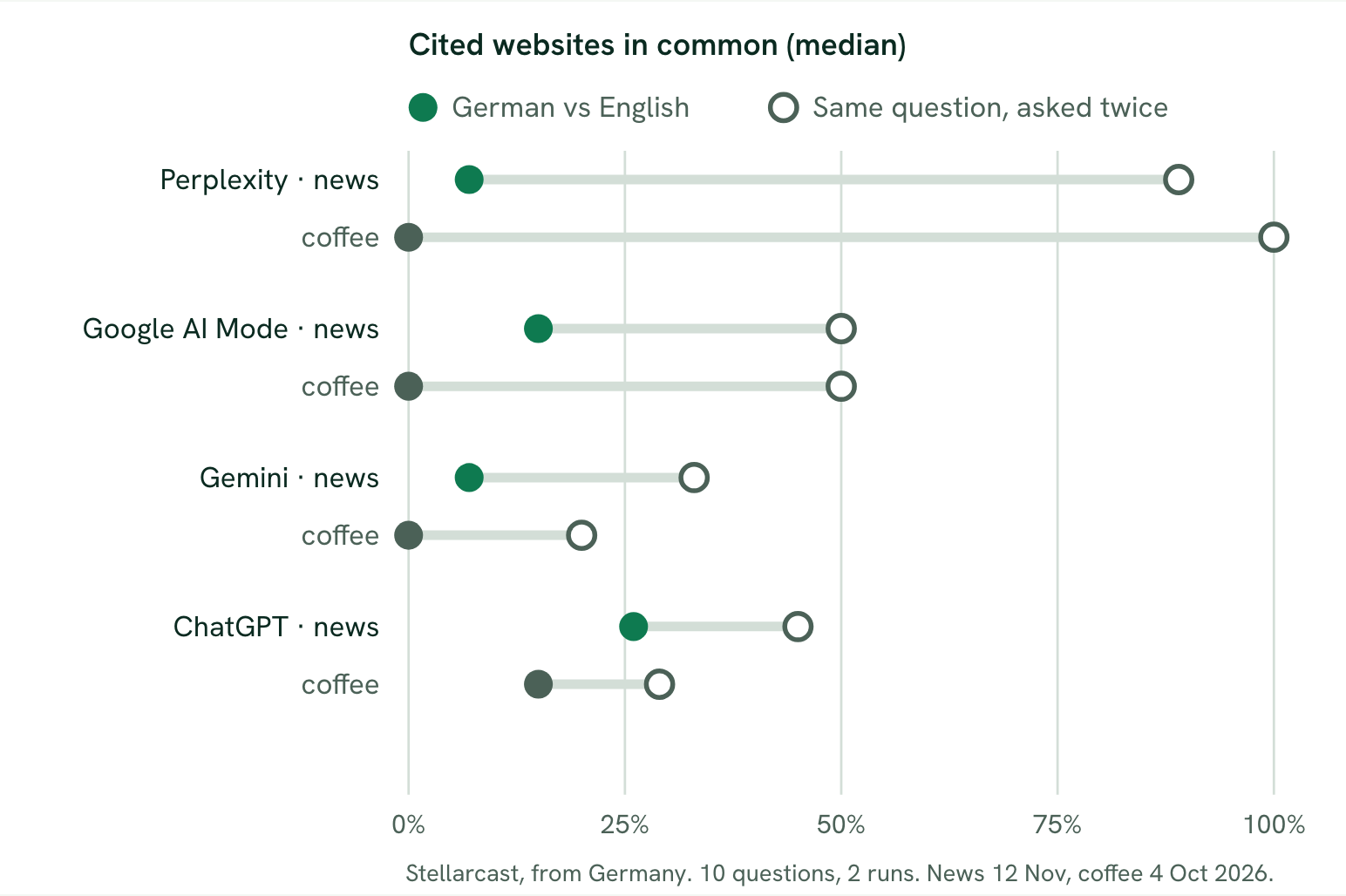 Median share of cited websites in common, per engine, asked from Germany. Perplexity, news: 7% German vs English, 89% same question asked twice; Perplexity, coffee: 0% German vs English, 100% same question asked twice; Google AI Mode, news: 15% German vs English, 50% same question asked twice; Google AI Mode, coffee: 0% German vs English, 50% same question asked twice; Gemini, news: 7% German vs English, 33% same question asked twice; Gemini, coffee: 0% German vs English, 20% same question asked twice; ChatGPT, news: 26% German vs English, 45% same question asked twice; ChatGPT, coffee: 15% German vs English, 29% same question asked twice.
| Engine | German vs English | Same question asked twice | Questions where the language gap was bigger | Coffee, same measure (German vs English / twice) |
|---|---|---|---|---|
| Perplexity | 7% | 89% | 10 of 10 | 0% / 100% |
| Google AI Mode | 15% | 50% | 10 of 10 | 0% / 50% |
| Gemini | 7% | 33% | 9 of 10 | 0% / 20% |
| ChatGPT | 26% | 45% | 9 of 10 | 15% / 29% |
On every engine, German and English answers shared far fewer websites than two runs of the same question did. The gap is a little smaller than it was for coffee: news answers in the two languages shared a median 7-26% of their websites, depending on the engine, where coffee answers shared 0-15%. That fits the intuition that news sources are less local than coffee brands. With ten questions per study, run five weeks apart, treat that difference as a pointer rather than a measurement.
Perplexity was again the clearest case. Asked the same question twice, it cited almost the same websites (89% in common). Asked in English instead of German, it kept almost none of them (7%).
Finding 2: English answers rarely reach German newsrooms
Share of each answer's citations on .de domains, and on German-language news publishers (national and regional papers, public broadcasters and German-language news agencies, from a list we classified by hand). Medians per answer:
| Engine | .de, German | .de, English | German newsrooms, German | German newsrooms, English | Questions where German was higher |
|---|---|---|---|---|---|
| Perplexity | 100% | 10% | 80% | 0% | 10 of 10 |
| Google AI Mode | 75% | 50% | 37% | 0% | 9 of 10 |
| Gemini | 87% | 33% | 42% | 0% | 9 of 10 |
| ChatGPT | 86% | 69% | 33% | 18% | 5 of 10 |
Across all 1,364 citations, German answers put 49% on German newsrooms and English answers 11%. English answers asked from Germany still cited plenty of German websites, but mostly government and institutional ones (the federal government's and the Bundestag's own sites) and English-language sites about Germany, not German newsrooms.
ChatGPT was the exception. Its English answers kept a median 18% of their citations on German news outlets, and it cited German newsrooms more in German on only 5 of 10 questions.
Finding 3: regional outlets appear only in German
The outlets cited in both languages were the big national and international names: tagesschau.de, Süddeutsche Zeitung, ZDFheute, Deutschlandfunk, Reuters, AP, Deutsche Welle. Even those were skewed. German answers leaned on the public broadcasters and the Süddeutsche; English answers on Reuters, AP and DW's English service.
Regional and local outlets showed up only when the question was asked in German: NDR, BR, Merkur, Volksstimme, WAZ, HNA, Mittelbayerische Zeitung, Frankfurter Rundschau, Märkische Oderzeitung and others, each in a handful of answers. English answers instead brought in international titles that German answers never cited, such as CBS News, The New York Times, CNBC, Le Monde, The Local and Clean Energy Wire.
It did not run entirely one way. A few German-language outlets, among them Correctiv, Bild and the Börsen-Zeitung, appeared only in English answers, once or twice each.
Where language mattered less
We would rather show where the effect was weak than average it away:
- ChatGPT on three questions. On electricity prices, pensions and conscription, ChatGPT's German and English answers differed by about as much as two runs of the same question. On conscription the language gap was slightly smaller than the run-to-run difference.
- Gemini on reliable political news. In one of the two runs in each language, Gemini answered without citing any website, so there was nothing to compare on that question.
- Munich. The one question where English answers also cited a German newsroom heavily: the Süddeutsche Zeitung, a Munich paper, appeared in English answers as well as German ones.
Per question
All four engines pooled, medians:
| # | Question | German vs English | Asked twice | Engines where the language gap was bigger | German newsrooms, German | German newsrooms, English |
|---|---|---|---|---|---|---|
| 1 | Federal budget 2027 | 13% | 46% | 4 of 4 | 51% | 0% |
| 2 | Electricity prices | 7% | 45% | 4 of 4 | 0% | 0% |
| 3 | Pensions dispute | 12% | 50% | 4 of 4 | 66% | 20% |
| 4 | Conscription | 12% | 72% | 3 of 4 | 33% | 0% |
| 5 | US midterms 2026 | 23% | 50% | 4 of 4 | 50% | 0% |
| 6 | War in Ukraine | 10% | 35% | 4 of 4 | 62% | 0% |
| 7 | Mecklenburg-Vorpommern state election | 23% | 71% | 4 of 4 | 33% | 0% |
| 8 | Munich news this week | 23% | 38% | 4 of 4 | 58% | 40% |
| 9 | Reliable news on German politics | 0% | 42% | 3 of 4 | 44% | 0% |
| 10 | Reliable business and finance news | 3% | 48% | 4 of 4 | 33% | 0% |
On electricity prices neither language cited newsrooms much: answers leaned on price-comparison, advice and energy-industry sites. The two "where can I read reliable news" questions had the least overlap of all.
The questions
| # | German | English |
|---|---|---|
| 1 | Wie ist der aktuelle Stand beim Bundeshaushalt 2027? | What is the current status of Germany's 2027 federal budget? |
| 2 | Warum sind die Strompreise in Deutschland so hoch und werden sie bald sinken? | Why are electricity prices in Germany so high, and will they come down soon? |
| 3 | Worüber streitet die Bundesregierung gerade bei der Rente? | What is the German government currently arguing about on pensions? |
| 4 | Was ist der aktuelle Stand bei der Wehrpflicht in Deutschland? | What is the current status of military service (conscription) in Germany? |
| 5 | Wie sind die US-Zwischenwahlen 2026 ausgegangen? | What was the outcome of the 2026 US midterm elections? |
| 6 | Wie ist die aktuelle Lage im Krieg in der Ukraine? | What is the current situation in the war in Ukraine? |
| 7 | Wie ist die Landtagswahl 2026 in Mecklenburg-Vorpommern ausgegangen? | What was the outcome of the 2026 state election in Mecklenburg-Vorpommern? |
| 8 | Was sind die wichtigsten Nachrichten aus München diese Woche? | What are the most important news stories from Munich this week? |
| 9 | Wo kann ich verlässliche Nachrichten über die deutsche Politik lesen? | Where can I read reliable news about German politics? |
| 10 | Wo finde ich seriöse Nachrichten über Wirtschaft und Finanzen? | Where can I find reliable news about business and finance? |
What this suggests for publishers and brands
Cautious readings of a small study, not rules:
- Language decides which newsrooms an AI answer draws on. In our sample, a reader asking in English from Germany almost never saw German newsrooms cited, even on purely German stories like the federal budget or pensions.
- Regional publishers are visible in their own language only. Regional titles appeared only in German answers. If you measure how often AI engines cite your newsroom, measure in the language your readers use.
- Check run-to-run variation before reading a difference. Some engines change a large share of their sources between two identical questions asked minutes apart. A single check can make a gap look bigger or smaller than it is.
Limits of this study
- Small. Ten questions, two runs, one day, one country. Enough to see a consistent pattern, not enough for precise figures.
- Four engines. Microsoft Copilot is not included in this round.
- Same-afternoon runs. The two runs were minutes apart, so the yardstick is the smallest variation a reader would see. News sources probably change more from day to day than coffee sources, which would narrow the gap between the two columns. We did not measure that.
- The newsroom list is our own classification. We classified every news domain cited in the study by hand; the list is published. Borderline cases (the SPD paper Vorwärts, the church weekly Sonntagsblatt, Correctiv and Swiss SRF) count as German-language newsrooms. Leaving them out moves the all-engine German median from 44% to 43%. The .de share is a separate, mechanical measure.
- Exact website matching. zdf.de and zdfheute.de count as different websites. This lowers the overlap in both columns alike.
- Sources, not accuracy. We measured which websites the answers cited, not whether the answers were right.
Use this chart
The chart is free to reuse under CC BY 4.0: credit Stellarcast and link to this page. The embed code does both for you.
Coverage
Ulrike Langer reported these findings as an exclusive in News Machines, her newsletter on AI in journalism, after working through the raw data herself: “Why AI assistants drop German newsrooms when you ask in English” (17 November 2026), also published in German as “Warum KI-Assistenten deutsche Medien ausblenden, wenn man auf Englisch fragt”.
Cite or reuse this study
The data and the chart are free to reuse under CC BY 4.0. If you quote a figure or use the chart, please link to this page so readers can see the method and the limits above. To cite it:
Goyal, S. (2026). "Ask AI about German news in German or in English, and it reads different newsrooms." Stellarcast. https://stellarcast.ai/blog/ai-news-answers-german-english/
- Cited websites in common, as CSV (the Finding 1 table, with the coffee comparison)
- .de and German newsroom shares, as CSV (the Finding 2 table)
- Every answer, as CSV (engine, language, question, run, and the domains cited, in order)
- The German newsroom list, as CSV
- The October study this follows: ask an AI engine in the local language and it names different brands
If you are comparing AI visibility tools to track your brand per market, these guides set the options side by side:

See which sources AI engines cite in your markets
Stellarcast measures whether your brand is named and cited in AI answers, per market and in each market's language, and shows how settled each reading is.
Get your free visibility audit